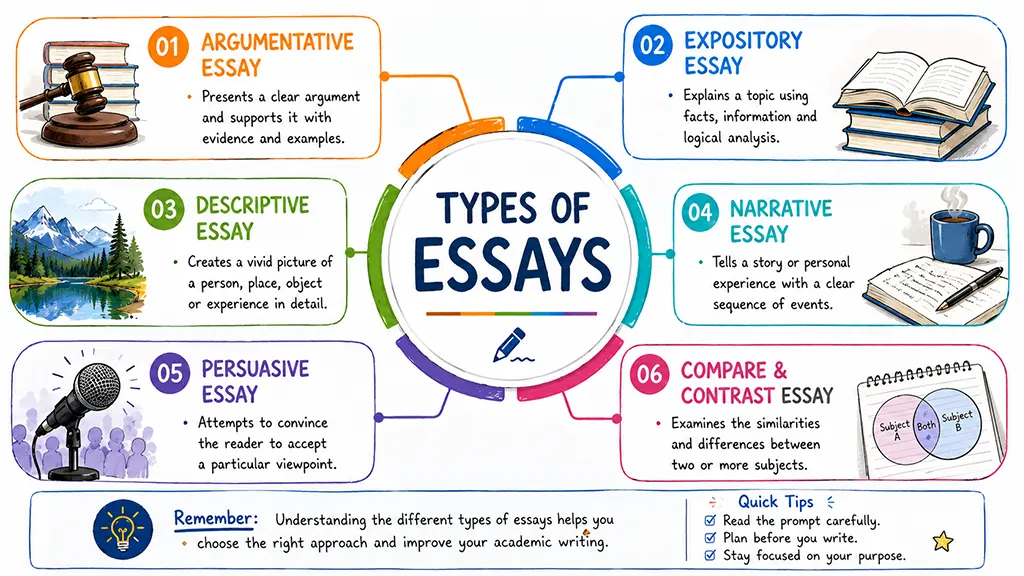
 By
By Essay writing is an essential part of university coursework. University professors assign essays to assess your capability to present your thoughts in a structured writing style. They also determine how well you understand the complex theories and concepts of various subjects.
There is also a misconception among students that all essays have the same format. This is not true because different academic goals require different essay formats to meet university standards or subject criteria. Therefore, if students know the correct essay type for a particular assignment, they can write their ideas very clearly.
If you want to explore common types of essays and their purposes, read along with this guide.
What Is an Essay?
Most students often confuse essays with regular assignments. There is a huge difference between an essay and an assignment.
An assignment is any type of task or project assigned by a teacher. The nature of this work is broad, as it can be a quiz, a worksheet, a science lab project, a PowerPoint presentation, or a simple drawing. You may have to give short answers, one-word answers, problem sets, or detailed reasoning.
An essay is a specific type of writing task that has a clear purpose. You can’t write your essay without following a proper structure. The sequence follows an introduction, main body paragraphs, and a conclusion. Essays are usually very lengthy, with up to 4000 words, where the student explains an idea or justifies a thesis statement. However, all essays have different purposes; there are different types of essays.
Structure of a Standard Academic Essay:
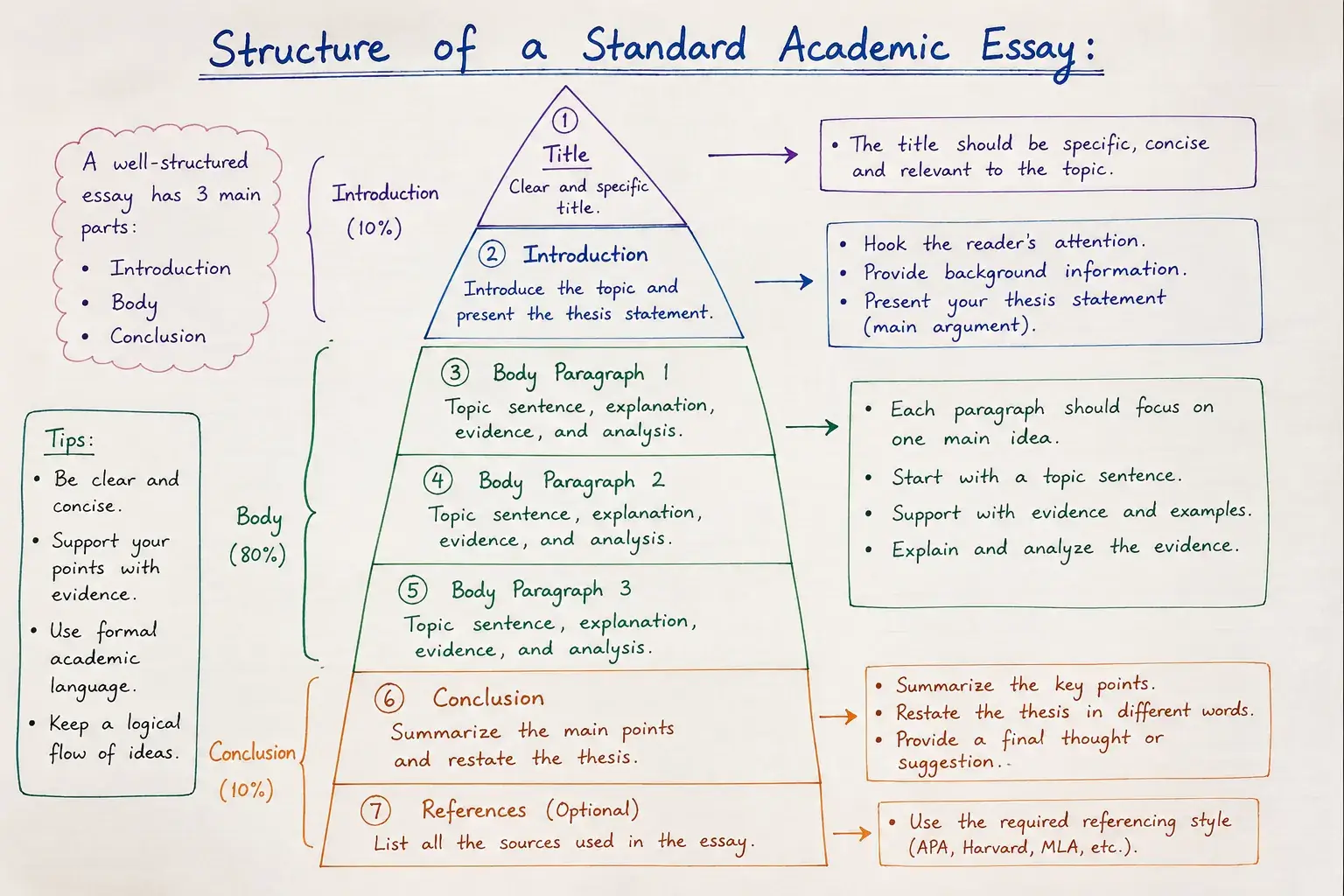
The core structure of an essay has three main parts that include an introduction, body paragraphs, and a conclusion to summarize the final thoughts.
Introduction
This is the most important part of your essay. It’s usually about 50 to 120 words, but the first sentence is the hook that captures the reader’s attention. It should be written very carefully, as it decides whether the reader will continue reading your document. After the hook, you mention brief facts about the topic’s background. Lastly, you write a clear sentence, also known as a thesis statement, that presents your main argument.
Body Paragraphs:
This section requires you to discuss the main points in detail. The number of paragraphs depends on your choice. The more lengthy the topic is, the more paragraphs you add. Each paragraph starts with an interesting sentence to discuss different ideas. This includes important evidence like facts and figures, quotes from credible authors, and statistics.
You also explain all your data and information in a detailed analysis. The main purpose is to justify your reasoning with evidence and why the evidence is important. When writing, make sure that each sentence connects the previous paragraph to the next paragraph for better understanding.
Conclusion
This is the last paragraph of your essay that sums up your entire writing in a single consolidated perspective. That idea could be your personal opinion, a learning outcome, or a final analysis. While writing, you remind the reader of your main key points with new words. Also, you briefly recap your main body statements. End it with a final verdict that leaves an impact.
Purpose of Academic Essays:
Different types of essays serve unique and distinct academic purposes. Each purpose highlights your knowledge of a specific subject and answers a specific question.
For example, if it’s a historical essay on a disputed topic like “Who was responsible for the onset of World War 1?”, then the purpose would be the student’s decision to choose a side. Therefore, the instructor would be able to judge your morality and how well you can establish political reasoning to justify your points.
They also test your understanding of course topics if you’ve done extensive research. Students get awarded the highest grades when they share their ideas clearly and persuasively.
Essays Improve Academic Growth of Students:
You eventually become what you’ve learned. Writing long essays based on heavy research work strengthens your intellect. Students develop their cognitive learning and improve decision-making.
These are the three core elements responsible for your cognitive growth:
- Critical Thinking:
Critical thinking means closely observing information and forming wise opinions to solve problems. You aim to find the truth to avoid falling into the trap of false information. You question basic facts, look at perspectives from different angles, decide whether the sources are strong or weak, and form your own original ideas.
- Research Skills:
It means finding credible sources of literature and reading dense information to get new ideas for using in your writing. The sources include textbooks, trusted websites, documentaries, authorized articles, and published journals. After collecting information from various sources, key facts are grouped to form further analysis. For great research, it is important to cross-check the facts from other trusted sources and recognize biases or hidden perspectives.
- Argument-Building Skills:
This is the part where you use all of the shortlisted evidence and facts to prove your main argument. The ideas should be presented in a logical order to state your main statement. Students must present a deep connection between their main argument and evidence to counter-argue safely.
Need an expert’s help with your university essay?
From comprehensive research to presenting your ideas on paper, get full academic assistance at affordable rates.

10 Different Types of Essays Students Should Know
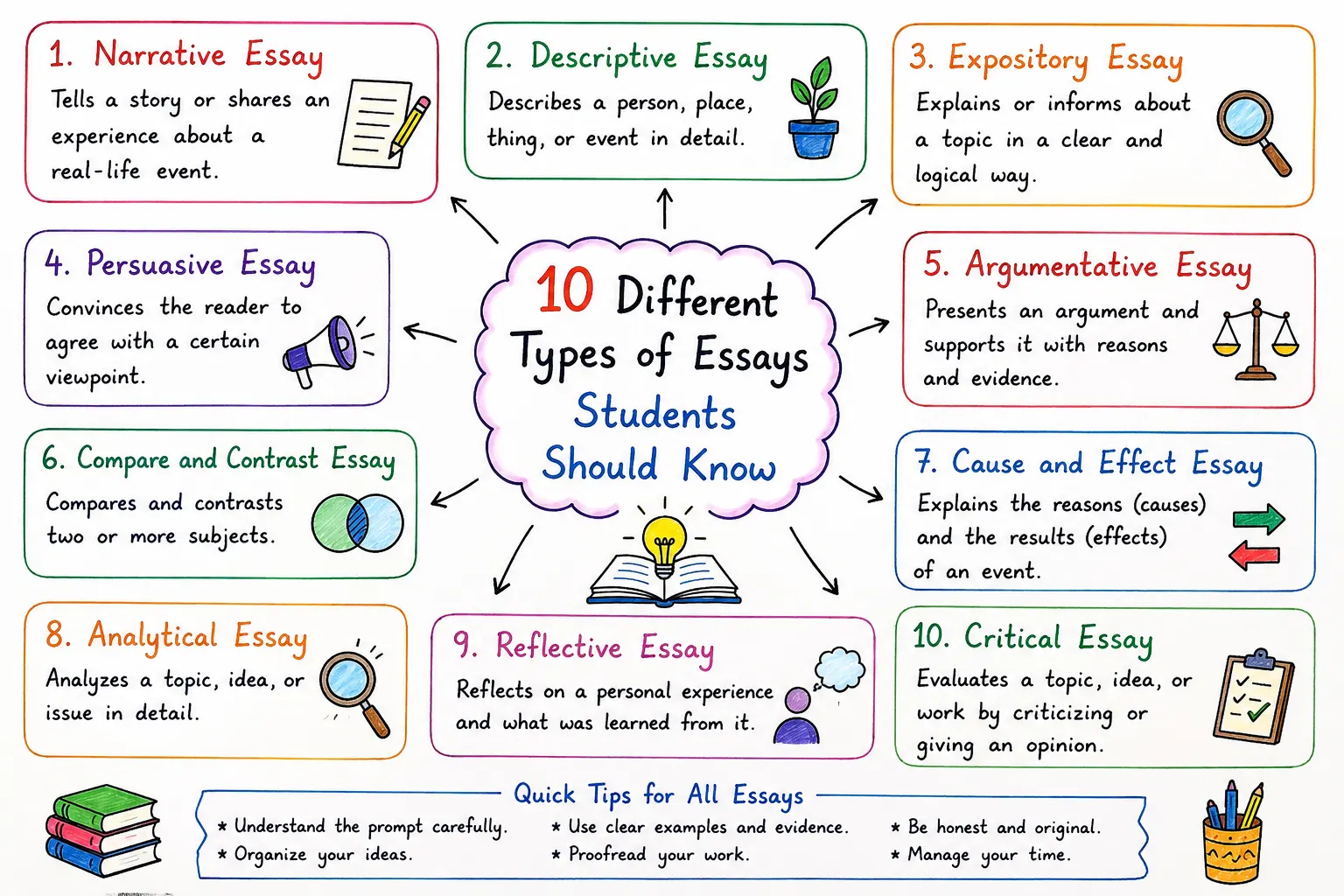
There are different types of essays, and each essay style has a unique goal. Teachers assign their students different essays so they can organize their ideas in various formats required for academic evaluation.
Here are the most common academic essay types:
1. Argumentative Essay:
It is a formal type of writing that requires the student to investigate a conflicted or debatable topic and take a clear stance based on research, facts, and logical reasoning.
Purpose: It aims to convince the reader to understand and agree with your point of view. You also demonstrate your deep knowledge of an issue by studying it from multiple angles. Teachers assign argumentative essays to examine the student’s critical thinking and research skills.
Main Features:
- A clear thesis statement in the introduction to present your exact objective of the topic
- Mention factual events, statistics, and real examples to support your claim
- Use counterarguments to oppose the strongest opinions with logic and analysis and weaken the opposite statement
Example Topics:
- Should university fees be free for all students?
- Is remote work more productive than office work?
- Does social media hurt our sleep cycle?
2. Analytical Essay:
It is an academic writing that deconstructs a specific topic and evaluates its main components separately. The writer focuses on answering how and why the main components create the fuller meaning of that topic.
Purpose: It helps the student to interpret difficult topics and communicate evidence-based conclusions correctly. You can identify the hidden behaviors or themes behind a study. You also develop critical thinking and evaluation skills.
Main Features:
- A debatable opening statement that sets the tone of the essay
- Breaking down the whole topic into smaller topics
- Present direct quotes or facts to support your interpretation
- Write in the third person to focus on facts rather than personal opinions
- Each claim should be supported with an explanation
Example Topics:
- An analysis of the underlying themes of marriage in Jane Austen’s novels.
- How camera angles and lighting focus created tension in Alfred Hitchcock’s Rear Window.
- The psychological reasons behind Hamlet’s hesitation to seek revenge.
3. Descriptive Essay:
It is a creative style essay that portrays a specific topic by focusing on physical attributes or abstract ideas. Instead of research findings, you rely on general observations.
Purpose: It creates a visual illustration of the writer’s thoughts and unique ideas in the reader’s imagination.
Main Features:
- The writer uses appealing words to evoke sight, sound, smell, touch, and taste.
- Mostly figurative language is used, such as similes, metaphors, and epithets for comparisons
- Always use descriptive action verbs and particular nouns rather than plain adjectives
Example Topics:
- My Childhood Bedroom
- A mysterious stranger I met on a bus
- A family heirloom bracelet I still cherish
- A rainy day
4. Narrative Essay:
It is a structured, non-fiction essay that tells a real-life event or personal experience. For narration, first-person pronouns like “I” or “my” are used to connect it to a greater meaning or life lesson.
Purpose: It is written to share a personal experience with a memory or event with an audience and to make the reader feel emotions on a human level. This way, you show your personal growth or how your perspective changed.
Main Features:
- Use “I” or “we” to give a personal touch in the writing.
- The plot starts with an introduction, follows a rising or climax part, and ends with an important lesson, decision, or firm resolution.
- You also introduce the real people you encountered at a specific time or place and provide sensory details to give life to your writing.
- Also reflect on why the event is important to you
Example Topics:
- The moment you failed a competition, and it taught you an important lesson
- A memorable trip with your best friend that changed your perspective of friendship
- How you overcame a challenge
5. Persuasive Essay:
When you persuade someone, you try your best to convince them to agree with your thoughts. Similarly, a persuasive essay tries to make the reader accept your opinion or ideas.
Purpose: When writing a persuasive essay, your main goal is to make the readers believe your ideas are logical. You can support your ideas further with authentic facts and evidence.
Main Features:
- You should begin with a solid sentence in the first paragraph to state your exact claim
- Students must use real-life examples to back up their ideas
- Use emotional language to evoke the reader’s feelings
- You should also mention your counterarguments in response to the opposite side and explain why it’s wrong
- Finish by summarizing all ideas with a strong call to action.
Example Topics:
- Why should plastic water bottles and lunch boxes be banned in schools?
- Should daily physical exercise be mandatory in schools?
- Is animal testing for beauty products morally right?
6. Critical Essay:
A critical essay requires you to observe a specific topic from different angles and suggest their effectivenes or reliability. When you get assigned this type of assignment, you don’t simply state whether the ideas are reasonable or not. Instead, you observe its weaknesses and strengths before reaching a final verdict.
Purpose: You examine the validity and usefulness of a study. In addition, it also builds your critical thinking skills by breaking down larger concepts.
Main Features:
- You begin with a distinct central statement that defines your finding
- You must use direct quotes and specific examples from research to prove your opinions
- Your background information should be brief and used only as a base for analysis
- You must present claims logically in a formal tone. Also, write in third-person writing.
Example Topics:
- Evaluating how symbolism fuels power dynamics in George Orwell’s 1984
- Analyzing the validity of statements surrounding modern digital media addiction studies
- Critically examining the conflicting historical interpretations of the causes of the War of Independence 1957
7. Expository Essay:
This is a kind of writing based only on facts and real information. Here you don’t present your personal opinions but get ideas from authentic sources like journals, articles, or books. You simply answer the questions without trying too hard to make the reader agree with your biases.
Purpose: Its main goal is to help your reader to understand a concept or a process clearly by breaking down detailed ideas into simple parts. With this type of writing, you demonstrate your research and organizational skills to the teachers.
Main Features:
- Write a strong hook that grabs the reader’s attention
- Conclude with a clear statement to summarize the main ideas
- Write in third-person language
- Maintain a logical structure in each paragraph and back up your points with solid facts
Example Topics:
- How photosynthesis functions in plant cells
- The impact of data centers on water supply
- The cultural importance of jazz music in the 1920s
8. Compare and Contrast Essay:
When you write this type of essay, you closely observe two or more than two objects or theories and discuss their similarities and differences.
Purpose: Your goal is to let your readers choose between multiple options by deciding which one is the best, looking at their disadvantages and benefits.
Main Features:
- You can mention the main goals of the comparison
- You need to give equal importance to each subject to balance the content
- You can use block style (A and B) or point-by-point style (Point 1 for A and Point 2 for B)
- Students use transition words like “in contrast to,” “similarly,” and “comparatively.”
Example Topics:
- Hybrid job vs. in-office job
- Online classes vs. traditional classroom learning
- Electric oven and gas oven
9. Reflective Essay:
It is a type of writing where you use your personal life lessons or past events as the main topic and write in first person using “I” or “my.” It clearly focuses on your thoughts before and after.
Purpose: Your main goal is to show how personal growth changed your views. You should also state the reasons for your reactions and what others can learn from your experiences.
Main Features:
- You must keep the tone subjective by sharing honest feelings
- You should use first-person words like “I,” “me,” and “my.”
- Always end it with a key takeaway showing how you have changed or what you will do next time
Example Topics:
- A competition you failed and what it taught you
- How a specific movie changed your perspective about the world
- Your first day at a new job
10. Cause and Effect Essay:
This is a kind of writing where you explore how one thing leads to another. Imagine a domino effect. You also make readers understand the connection between certain situations.
Purpose: The purpose of writing this essay is to give logical reasons for a problem or an event in your opinion. Your main goal is to tell the readers why and how certain things happened.
Main Features:
- You must begin with a strong introduction
- Always use transition words like “therefore,” “because,” and “as a result.”
- You must first explain the causes and then the effects
Example Topics:
- What are the causes and effects of climate change
- Why yoga improves both mental and physical health
- The impact of hybrid jobs on modern businesses
How to Choose the Right Essay Type?
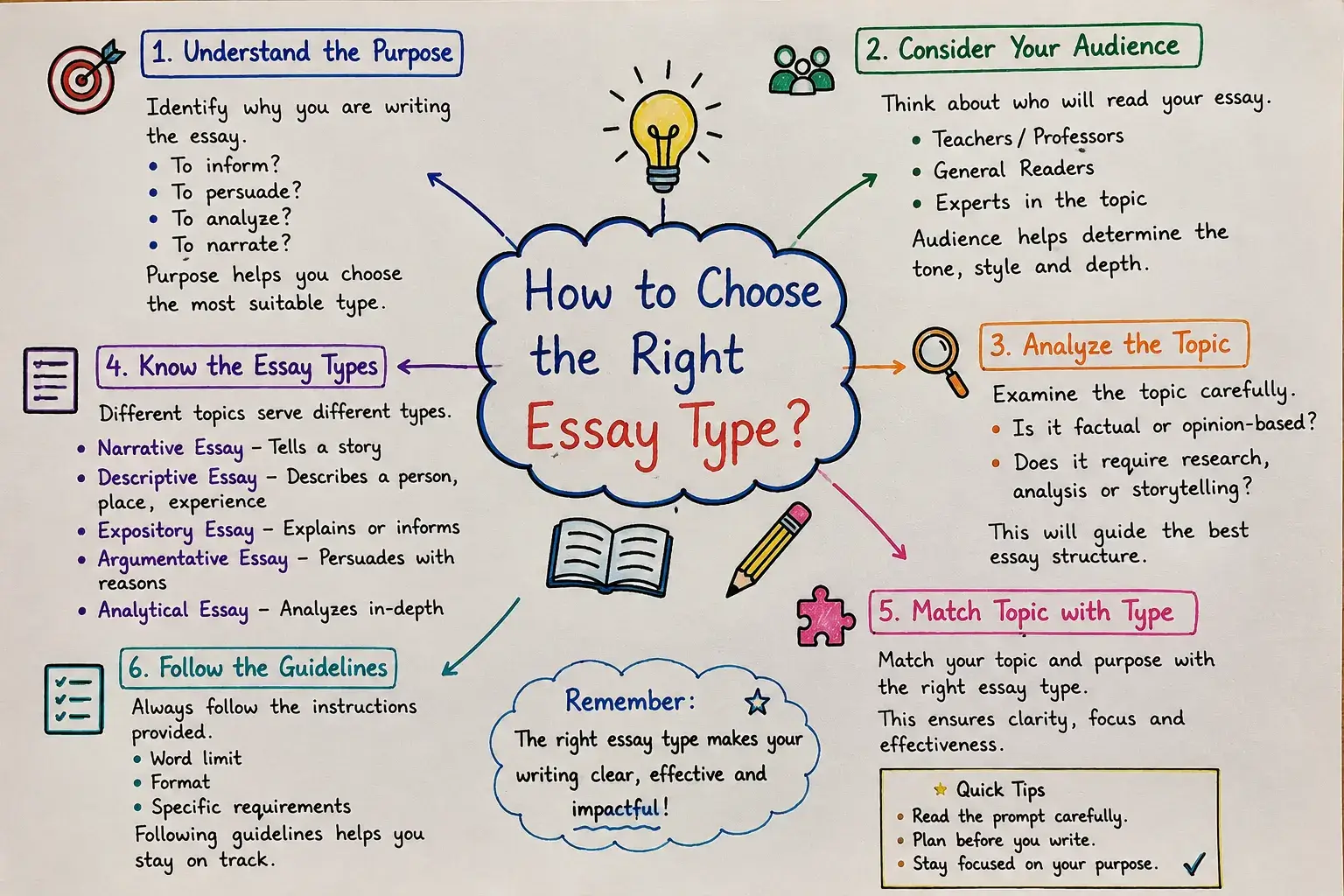
To decide which type of essay you should write, read your prompt very carefully.
Recognize the keywords that are mentioned in the examples given below:
- Discuss for an analytical essay
- Compare for a compare-and-contrast essay
- Describe for descriptive essay writing
Use the following checklist for more clarity:
- Identify the main verb in the essay title. This clearly states what your teacher asks you to do.
- Decide whether you’re required to inform, argue, or examine a topic.
- Ask your teacher to follow the specific rules, like referencing or subject requirements
Avoid common mistakes when writing essays:
- Don’t start with a weak statement. Remember that your opening sentence makes the first impression on the reader’s mind.
- Poor or incomplete research will make your essay look disorganized
- Don’t mention incorrect evidence. Always verify your facts by confirming the sources.
- Plagiarism is a rising issue in all types of academic writing. It leads to penalties for academic misconduct and discredits the student.
- Make sure your references match your citations, as incorrect referencing negatively impacts your grade.
Struggling to pick the right format for your academic essay?
Here at Write My Essay Qa, students get full writing assistance

Difference Between Essay Types:
| Type of Essay | Main Purpose | External Sources Required? | Writing Tone |
|---|---|---|---|
| Argumentative | Convince the reader of a specific idea | Yes (full research) | Objective, persuasive |
| Analytical | Break down and explain components. | Yes (data evidence) | Objective, critical |
| Descriptive | Create a real image using sensory details. | No (relies on personal observation) | Creative, sensory |
| Narrative | Share a personal story with deep experiences. | No (personal experience) | Introspective, natural |
| Persuasive | Move the reader to take an action. | Yes (facts + emotions) | Passionate, compelling |
| Critical | Judge the validity of a work | Yes (primary and secondary sources) | Analytical, evaluative |
| Expository | Explain a topic or process clearly. | Yes (factual data) | Neutral, informative |
| Compare & Contrast | Examine major similarities and differences. | Optional | Comparative, balanced |
| Reflective | Share personal growth from an experience. | No (personal experiences) | Self-reflective, personal |
| Cause & Effect | Explain specific reasons and outcomes. | Yes (data and facts) | Logical, explanatory |
FAQs:
What are the main types of essays?
There are many types of essays for different purposes, but the main types of essays are argumentative, expository, narrative, and descriptive.
Which essay type is most common in university?
The most common type of essay used in universities is an argumentative essay.
What is the difference between argumentative and persuasive essays?
An argumentative essay relies on evidence and logical reasoning, while a persuasive essay also uses emotional appeal and convincing language to influence the reader.
How do I choose the right essay type?
You must be very careful when choosing the right essay type. First, read the prompt attentively. Identify specific task verbs like analyze or explain and match them with your assignment requirements.
What is the easiest essay type to write?
There is no single essay type that is easiest for every student. Many students may find narrative essays more approachable because they can draw on personal experiences, but the difficulty depends on the topic, assignment requirements, and the writer’s strengths.
What is the structure of an academic essay?
Three parts make up the structure of an academic essay. The introduction, main body paragraphs, and conclusion.